By ChargeRFID
Review method: We checked this guide against the primary regulatory, protocol, and manufacturer references listed below. Product recommendations reflect ChargeRFID's manufacturing perspective and should be validated with your reader, charger, and backend.
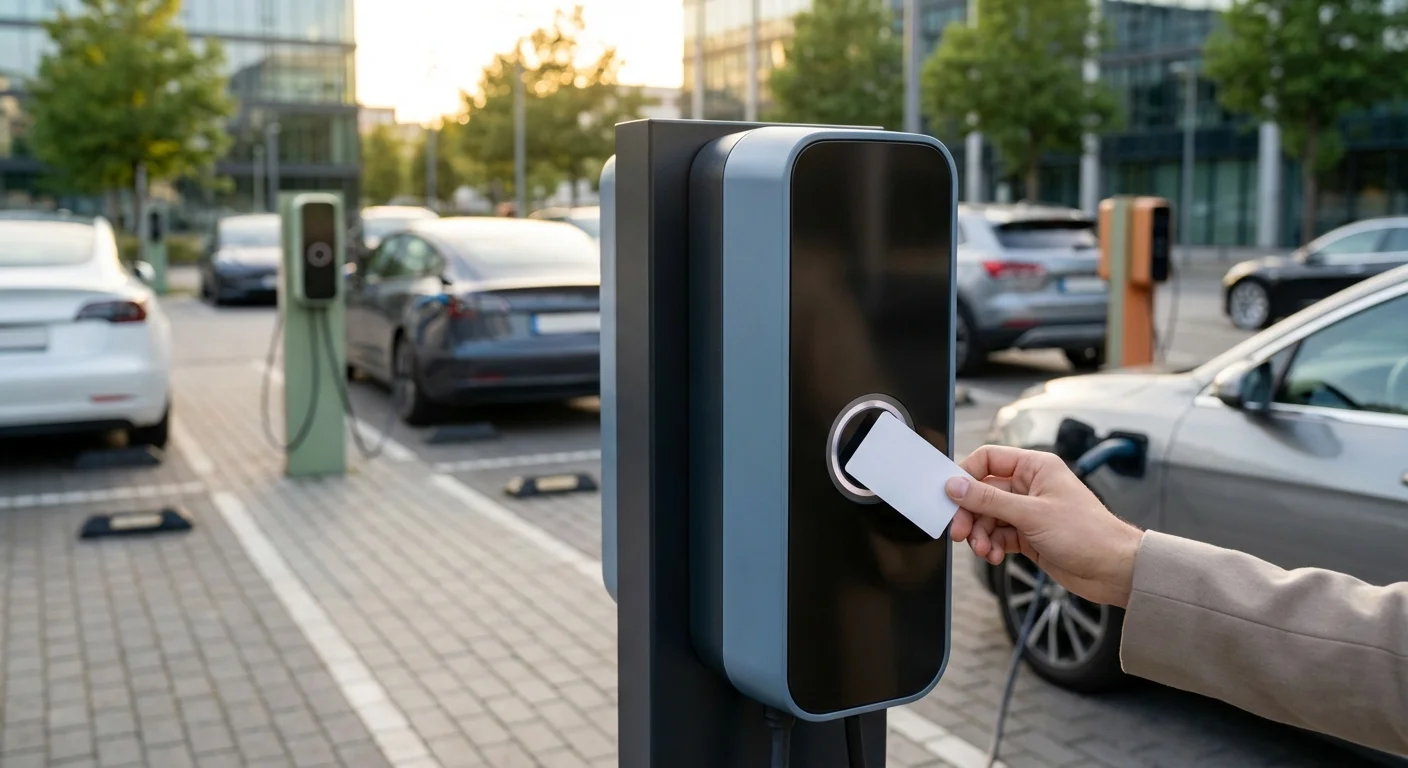
If you have ever driven an electric vehicle across multiple charging networks, you already know the frustration: a different app here, a separate RFID card there, and an entirely new account for the next provider down the road. For fleet operators managing dozens or hundreds of vehicles, this fragmentation multiplies into a logistical headache that wastes time, money, and driver patience. But the EV charging industry is finally solving this problem through RFID roaming, a system that lets one EV charging RFID card work seamlessly across competing networks, much like how a mobile phone connects to towers regardless of carrier.
The Fragmentation Problem: Too Many Cards, Too Many Apps
The European Alternative Fuels Observatory reported 1,155,861 publicly accessible recharging points in the EU in May 2026. While the raw infrastructure keeps growing, the user experience has not always kept pace. Each charge point operator (CPO) historically maintained its own app, membership card, and pricing structure. A driver crossing borders can still encounter several commercial networks even when the underlying technical protocols are interoperable.
For commercial fleets, fragmentation is more than an inconvenience. Fleet managers need consolidated invoicing, purchase controls, and visibility into charging costs across every vehicle. Handing each driver a stack of network-specific cards is not scalable.
How RFID Roaming Works Behind the Scenes
RFID roaming relies on a layered architecture of open protocols and roaming platforms that connect CPOs with e-mobility service providers (EMSPs). When a driver taps an RFID card at a charging station, the station's backend communicates with the roaming hub to verify the card, authorize the session, and route the billing data back to the driver's home provider. The entire handshake happens in seconds, invisible to the user.
Two protocol families commonly appear in this chain. The Open Charge Point Protocol (OCPP) standardizes communication between charging stations and their management systems. The Open Charge Point Interface (OCPI) handles data exchange between CPOs and e-mobility service providers. The EV Roaming Foundation's current public OCPI release is 2.3.0, while 2.2.1 remains widely implemented. a roaming provider integrations commonly use OICP instead of OCPI, so operators should confirm the protocol and version used by each partner rather than treating the acronyms as interchangeable.
On top of these protocols sit roaming platforms and bilateral partner connections. a roaming provider reports more than 1.1 million connected charge points and more than 3,500 B2B partners through intercharge; a roaming provider reported 695,000 connected charging points in February 2026. Those figures describe platform reach, not a guarantee that every card works at every listed charger. Actual access depends on the eMSP's active commercial agreements, token publication, tariff rules, and the host CPO's configuration.
Why Roaming Matters for Fleets and Businesses
For fleet operators transitioning from internal combustion to electric vehicles, RFID roaming solves several operational challenges at once. A single RFID card per driver means one invoice, one set of purchase controls, and one dashboard for monitoring energy costs. Fleet managers can set spending limits, restrict charging to approved networks, and track kilowatt-hour consumption across the entire fleet without reconciling data from a dozen different platforms.
The business case is straightforward: a fleet credential can link public-charging sessions to the same driver, vehicle, cost-centre, and invoice workflow used for depot charging. Roaming makes that consolidation possible, but the card itself is only the identifier. The eMSP, CPO, roaming connection, and fleet backend still determine coverage, tariffs, controls, and reporting.
For businesses that operate workplace or destination charging stations, RFID roaming opens a revenue stream. By connecting their chargers to a roaming network, property owners can offer charging to any driver with a compatible RFID card, not just employees or tenants. The roaming hub handles authentication, billing, and settlement automatically, turning a private amenity into a monetized service.
Regulation Is Accelerating Interoperability
The European Union's Alternative Fuels Infrastructure Regulation (AFIR) applies from April 2024. Its technical updates require publicly accessible AC and DC charging points installed or renovated from 8 January 2026 to comply with the listed EN ISO 15118 standards for interoperability. Separate implementing rules require the relevant alternative-fuels data model in DATEX II format from 14 April 2026. These obligations improve technical interoperability and data availability, but they do not create a universal commercial roaming agreement.
AFIR requires ad-hoc payment at publicly accessible points deployed from 13 April 2024. At points below 50 kW, a secure internet payment flow such as a session-specific QR code can qualify; points at or above 50 kW must offer a payment-card reader or a device with contactless functionality that can read payment cards. From 1 January 2027, that card/contactless requirement also covers existing points at or above 50 kW along TEN-T roads and at safe and secure parking areas. Contract RFID remains useful because an eMSP can attach negotiated tariffs, consolidated billing, and administrative controls to the token.
Regulatory payment access and contract-based RFID should therefore be treated as complementary paths. AFIR explicitly preserves the user's choice not to use automatic authentication and to select ad-hoc or another contract-based option where offered.
What to Look for in an RFID Charging Card
Not all RFID charging cards are created equal. When evaluating options for your fleet or business, consider the breadth of network coverage first. Cards connected to major roaming hubs like a roaming provider or a roaming provider will work at the largest number of stations. Check whether the card supports both AC and DC charging, since many fleet vehicles need fast DC charging on highways but use slower AC chargers at depots or workplaces.
Billing transparency matters, too. Some roaming agreements add markup fees on top of the CPO's base rate, which can erode savings. Look for providers that offer pass-through pricing or clearly disclose roaming surcharges. Finally, evaluate the management portal. The best fleet RFID solutions provide real-time dashboards, per-driver spending limits, customizable alerts, and exportable reports that integrate with existing fleet management software.
The EV charging landscape is moving toward a future where a single RFID card unlocks any charger, anywhere, with full cost transparency and centralized billing. The protocols are in place, the roaming platforms are scaling, and regulation is removing the last barriers. For fleet managers and businesses preparing for electrification, choosing the right RFID partner now will save years of operational complexity down the road.
Ready to find the right RFID charging solution for your fleet or business? Compare our RFID cards for EV charging — from recycled PVC to FSC wooden cards — or see how our fleet authentication and roaming solutions integrate with OCPP, a roaming provider, and a roaming provider. Contact our team to discuss your requirements and explore the options that fit your charging infrastructure needs.
Company, network and product names referenced in this article are the trademarks of their respective owners. They are used descriptively to identify systems our cards interoperate with. ChargeRFID is an independent manufacturer and this article does not assert any affiliation, partnership or endorsement.
Primary sources
Official references used to review the regulatory, protocol, and chip-level claims in this guide.
- Open Charge Point Interface (OCPI) specificationEV Roaming Foundation
- Open Charge Point Protocol (OCPP)Open Charge Alliance
- OICP 2.3 EMP API documentationHubject
- EU public recharging infrastructure data, June 2026European Alternative Fuels Observatory
Next step
Turn the research into a card specification.
Share the reader, chip, data or rollout context and we will identify the decisions required for samples and production.
Continue reading
Related Articles

RFID Cards for EV Charging: How They Work and How to Choose One
What an RFID card for EV charging actually does, how it authenticates against OCPP stations and roaming hubs, the chip technologies used, and how to choose the right card for fleets, networks, or personal use.
White-Label RFID Cards for E-Mobility Service Providers: The eMSP Playbook
An e-mobility service provider lives or dies by the moment a driver taps a card at a stranger's charger and it just works. Here is how white-label RFID cards, OCPI tokens, and clean UID provisioning let an eMSP put its brand on a credential that roams across hundreds of thousands of charge points.