Remove orphan access
Leavers, former residents and expired visitors need a defined block process; possession of the physical item is not the entitlement record.
Site access programme
Programme outcome
Controlled charging access by employee, resident, visitor, vehicle or account, with a practical offline and replacement policy.
Review recommended productDesigned for
Workplaces, depots, residential operators, hospitality groups and private charging sites
User groups
Employee, resident, visitor, contractor or fleet
Authorization
Central, cached or local-list behaviour
Formats
Card, keyfob or mixed issue
Control
Entitlement, expiry, block and replacement
Operating model / 01
The physical card is one controlled input. Reader behaviour, platform records and operating rules determine whether the correct account is authorized and traced.

An employee, resident, guest, contractor or fleet driver receives a credential with a defined entitlement and expiry rule.
The physical format is chosen around issue method, carrying behaviour, durability and the installed reader.
The station reader captures the identifier and uses central, cached or local authorization according to configuration.
User groups, chargers, access windows, tariffs and account mappings are controlled by the operating platform.
Issue, return, expiry, block and replacement actions are retained so physical access agrees with the live entitlement.
Specification matrix / 02
A production-ready brief states what must be decided, how it will be implemented and what evidence will count as acceptance.
Separate employees, residents, visitors, contractors, fleets and public users where their rules differ.
Each sample account receives only its intended charger and time entitlement.
Record charger models, reader technologies, firmware and management platforms across all sites.
The proposed credential is recognized at representative installations.
Define central, cached, local-list and offline-unknown behaviour per charger group.
Connected and disconnected tests match the site continuity policy.
Choose the platform field that connects the physical identifier to user, unit, vehicle or account.
A tap resolves to one current entitlement and one auditable record.
Set validity windows and return/block rules for temporary credentials.
Expired or returned credentials are rejected as designed.
Use cards for visible assignment and keyfobs for compact everyday carry; validate both if mixed.
Every format reads within the intended presentation area.
Define whether sessions are free, billed, reimbursed or allocated to a department or property account.
Pilot session exports contain the references required by finance or property management.
Failure controls / 03
Most failed launches are not caused by print quality. They come from unclear identifiers, untested readers, incomplete data ownership or weak lifecycle control.
Leavers, former residents and expired visitors need a defined block process; possession of the physical item is not the entitlement record.
Local authorization can support continuity, but list age and update behaviour must be tested so revoked access does not remain indefinitely.
Shared site cards reduce administrative work but also weaken accountability and session attribution.
Replacement and return rules should cover reception desks, property handovers, lost credentials and emergency issue.
Delivery path / 04
Each phase should close with evidence that can be reviewed by operations, platform and procurement teams.
Map sites, users, chargers, entitlements, tariffs and administration owners.
Site access policy and role matrix
Test proposed card and keyfob formats on representative stations and firmware versions.
Reader compatibility record
Create sample users for every group and test connected, offline, expiry and block behaviour.
Entitlement acceptance matrix
Assign and distribute credentials with a clear activation and custody record.
Issue register and user instructions
Review leavers, resident changes, visitors, losses and reorder stock on an agreed cadence.
Lifecycle and exception log
Responsibility boundary / 05
A precise boundary prevents the card from being blamed for configuration, entitlement or settlement decisions that live elsewhere.
Controls the approved material, chip, antenna, artwork, encoding, variable data, batch QC and production record.
Defines accepted identifier format, reader behaviour, token import, authorization states, security application and technical acceptance.
Owns assignment, activation, contracts, access policy, tariffs, customer support, replacement approval and end-of-life decisions.
Credential options / 06
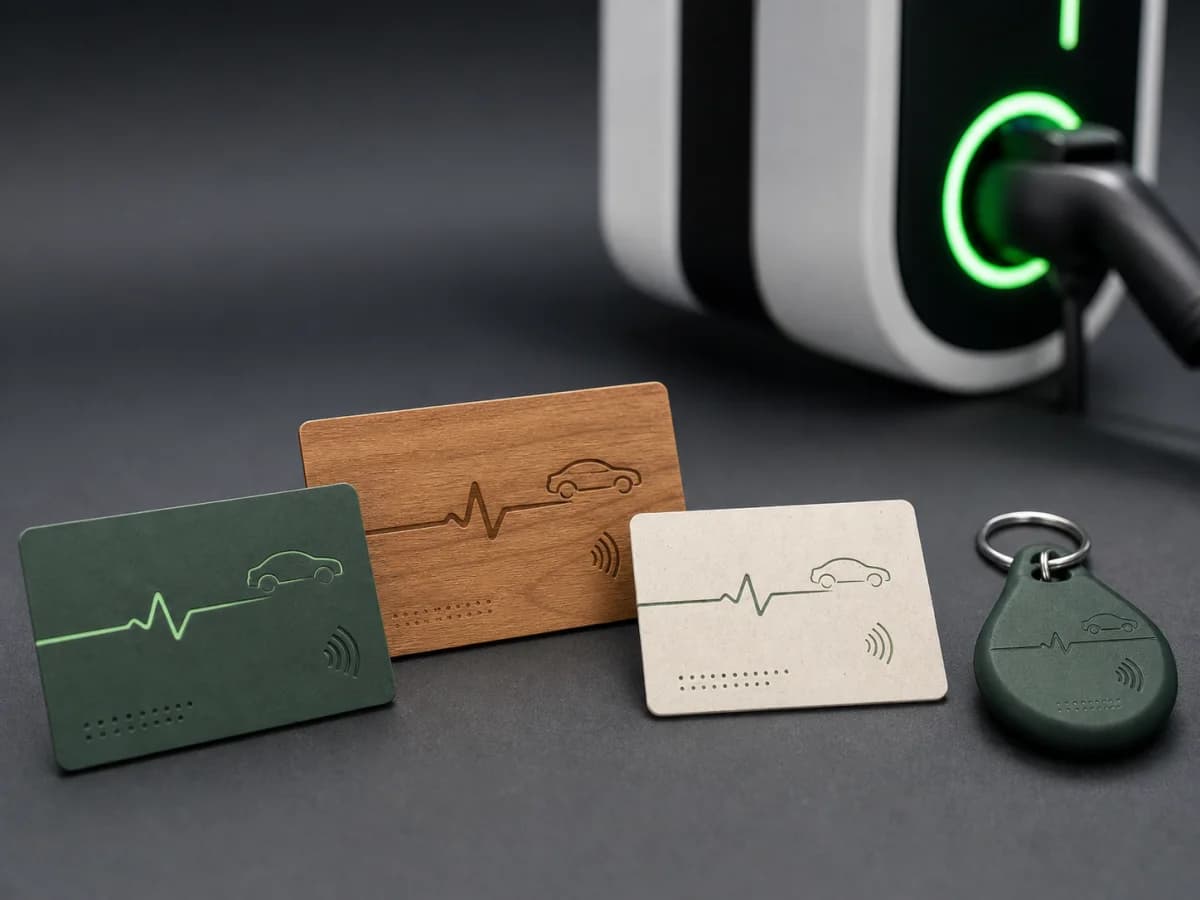
Custom Engineering / OEM/ODM / Prototype Validation
Custom RFID credentials engineered around your charging readers, token data, security model, form factor, artwork and fulfilment workflow.
Review recommended product
Recycled PVC / Custom RFID / UID Mapping
Custom RFID charging cards with a recycled-PVC card body, reader-matched chip options, programme artwork and UID-to-account data handoff.
Review recommended product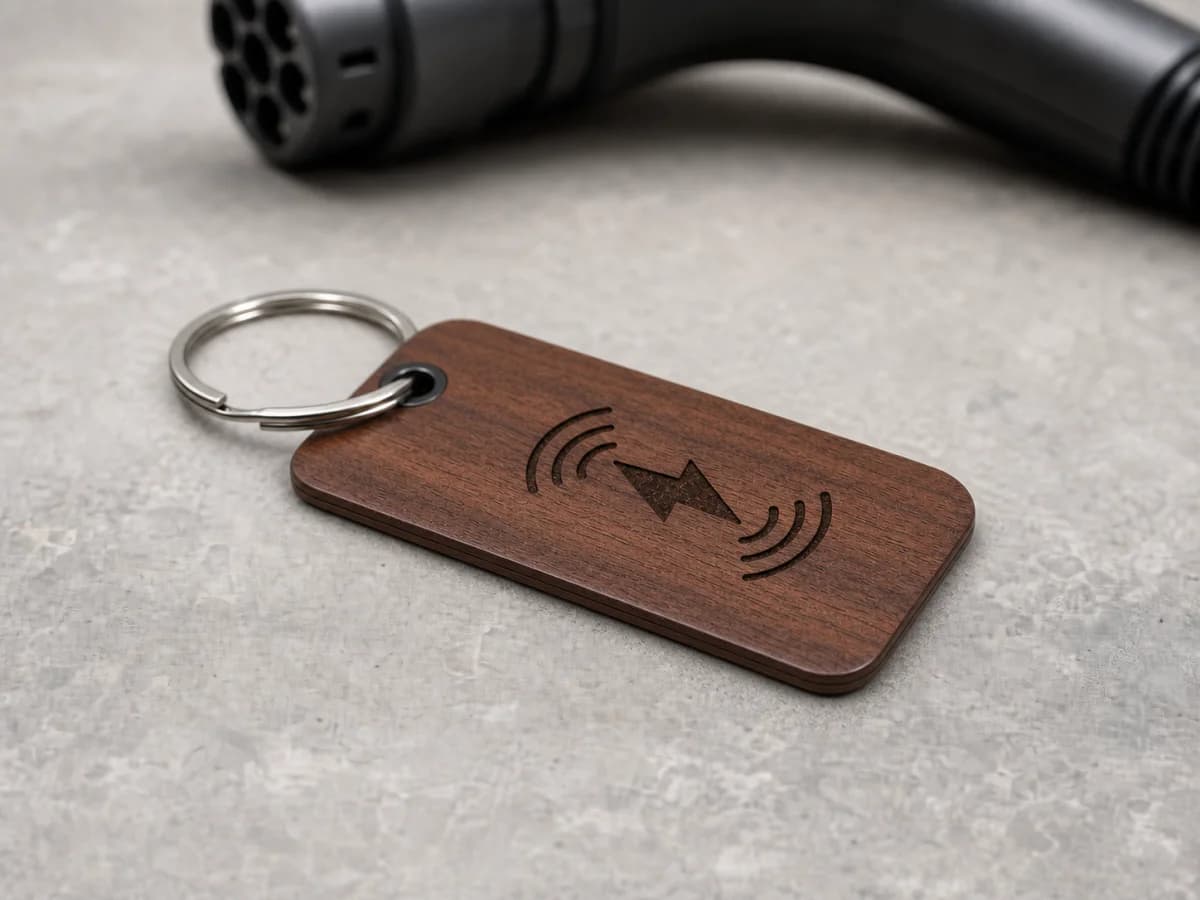
Wood · ABS · Epoxy · Crystal / Compact Credential / UID Mapping
Compact RFID charging credentials in FSC wood, moulded ABS, domed epoxy and transparent crystal-acrylic constructions.
Review recommended productTechnical library / 07
These sources define the surrounding technology and operating interfaces. ChargeRFID manufactures physical credentials; platform configuration, roaming contracts and charging-station certification remain with the relevant operators and vendors.

Technology / 5 min read
RFID Authentication Goes Embedded: Offline-Capable Charging Stations Reshape EV Infrastructure
Read More
Technology / 9 min read
What an RFID card for EV charging actually does, how it authenticates against OCPP stations and roaming hubs, the chip technologies used, and how to choose the right card for fleets, networks, or personal use.
Read More
Technology / 7 min read
A vendor-neutral method for choosing a 13.56 MHz EV charging credential by reader behavior, identifier format, authentication, backend controls and roaming requirements
Read MoreProgramme questions / 08
Possibly. OCPP implementations may use an authorization cache or local authorization list, but support and policy vary by station and CSMS. Test the exact disconnected behaviour before relying on it operationally.
Cards provide more visible space for names, numbers and instructions; keyfobs are compact and often easier for daily carry. Both can use the same identifier plan if the reader supports the selected chip and antenna format.
Expiry is normally controlled by the site or charging platform. The physical credential supplies the identifier; the platform applies the validity window and authorization state.
Yes, when the platform maps each identifier to the required cost centre, unit or account and exposes that reference in its session or billing exports.
Other operating programmes
RFID credentials for depot, workplace and public charging, with controlled driver or vehicle assignment, platform-ready identifiers and replacement records.
White-label cards and keyfobs prepared around your brand, identifier format, platform import, launch volume and repeat-order workflow.
Physical RFID credentials for roaming programmes where token records, identifier formats and lifecycle status stay consistent across eMSP, CPO and hub systems.
A controlled route from legacy or UID-only credentials to reader-matched card technology with a practical pilot, data plan and phased reissue.
Branded credentials for vehicle delivery, dealership charging, loyalty and premium member programmes—with controlled serialization and presentation.
Share the reader estate, identifier rules, security requirement, platform handoff, volume and rollout markets. We will return the questions needed for samples and production approval.