By ChargeRFID
Review method: This organization-authored article reflects ChargeRFID's manufacturing perspective. Confirm chip, reader, charger, and backend compatibility in your own environment before ordering.
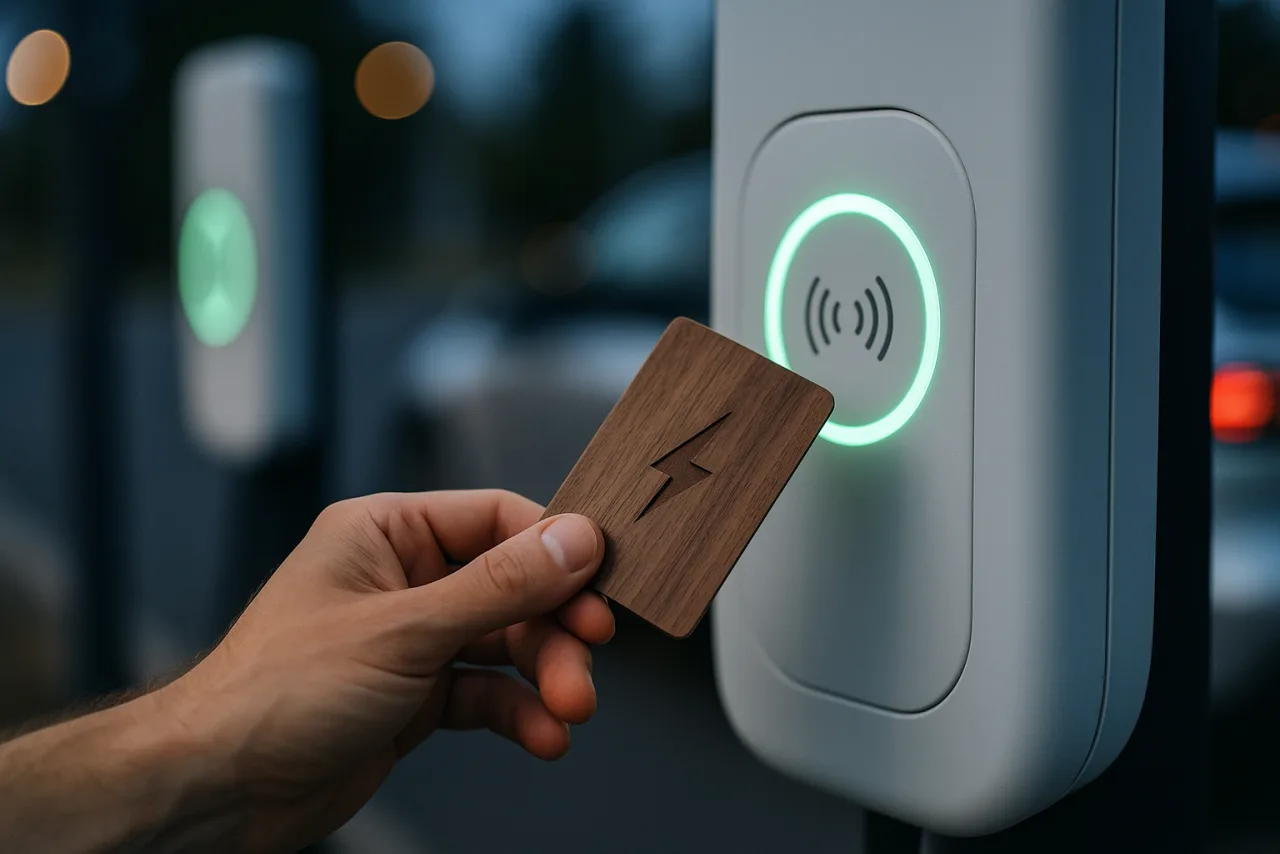
An e-mobility service provider (eMSP) does not own a single charging station, yet it is the brand a driver sees. The eMSP aggregates access to charge points operated by many different charge point operators (CPOs), bundles them into one account, one app, and one credential, and handles authentication and billing so the driver never thinks about who actually owns the hardware. For most eMSPs, the physical embodiment of that promise is a small piece of plastic — or wood, or recycled PVC — with the provider's logo on it: a white-label RFID card. Get the card right and the brand feels effortless everywhere. Get it wrong and every tap is a support ticket.
The eMSP and CPO, in One Picture
The EV charging market is split into two roles that are easy to confuse. The CPO owns and operates the charging hardware — the physical stations, the energy connection, the maintenance. The eMSP owns the customer relationship — the account, the app, the card, the consolidated invoice. A driver subscribes to an eMSP; the eMSP arranges, through roaming agreements, for that driver's credential to be accepted at CPOs it has never physically touched.
The RFID card is the bridge. When a driver taps at a CPO's charger, the charger reads the card, sees a credential it does not recognize locally, and asks: who vouches for this? The answer travels back, through roaming, to the eMSP that issued it. That round trip is the entire business, and it hinges on one humble number printed invisibly into the chip: the UID.
The UID Is the Product
Every contactless EV charging card carries a unique identifier (UID) in its chip. When a charger's reader scans the card, the UID is what it captures and forwards for authorization. In the language of the Open Charge Point Interface (OCPI) — the protocol that lets eMSPs and CPOs exchange authorization and session data in real time — that card is a token of type RFID, and its UID is the field CPO systems use to recognize it.
This is why provisioning discipline matters more than anything else in a white-label program. For a card to work across a roaming network, three things must line up: the UID physically encoded on the chip, the token record the eMSP registers in its backend, and the data shared with CPO partners over OCPI. If the UID a CPO reads does not exactly match the token the eMSP published, authorization fails — and it fails at the worst possible moment, with a driver standing in the rain at a charger that will not start. A reliable card manufacturer delivers UIDs in a clean, exportable format that drops straight into the eMSP's token provisioning, so every card in a batch is registered correctly before it ever reaches a driver.
Why White-Label, Not Generic
An eMSP could hand out anonymous cards. The ones that build a brand do not. A white-label card carries the provider's logo, colors, and finish, and it becomes a daily, physical touchpoint — sitting in a cup holder, handed to a new subscriber in a welcome kit, pulled out at a charger in front of other drivers. For a provider competing on experience rather than owning infrastructure, that card is one of the few tangible things the customer actually holds.
White-labeling also lets an eMSP extend its reach through partners. A provider can supply branded cards to a fleet operator, a workplace, or a regional partner, putting the partner's identity on the front while the eMSP's authentication and billing run underneath. The card market has matured to support this: providers can specify sustainable materials — recycled PVC, FSC-certified wood, or bio-based stock — to align the credential with the environmental story that sells EV charging in the first place, without compromising the chip performance that makes it work at the pedestal.
eMAID, Contract IDs, and the Move Beyond the Card
The card is the most visible credential, but it is not the only identity in play. As Plug and Charge spreads, drivers are also identified by an e-Mobility Account Identifier (eMAID, sometimes written eMA-ID) — a standardized contract ID that ties a vehicle's charging session to an eMSP account through digital certificates rather than a physical tap. Forward-looking eMSPs treat the RFID card and the eMAID as two front-ends to the same account: a driver taps a card today and lets the car authenticate itself tomorrow, and the billing, roaming, and reporting underneath are identical.
For an eMSP building its credential strategy now, the practical implication is to keep the account layer independent of the authentication method. The card, the app token, and the eMAID are all just ways of saying "this is my driver" — the value is in the roaming reach and the clean invoice behind them.
What to Demand From a Card Program
For an eMSP specifying a white-label RFID program, a short list separates a credential that scales from one that generates support load. Insist on chips with broad reader compatibility, so the card authenticates reliably across the widest possible range of CPO hardware. Require UID data delivered in a clean, bulk-importable format that maps directly to OCPI token provisioning, so registration is automatic rather than manual. Specify the brand finish and material — including sustainable options — that fit the provider's identity. And confirm the manufacturer understands the roaming context, not just card printing, so the credential is built for the network it has to survive in.
An eMSP's brand travels on a card it does not control to chargers it does not own. The providers that win make that card invisible in the only way that matters: it simply works, every time, everywhere.
Building or scaling an e-mobility service? Contact our team to specify white-label RFID cards — recycled PVC, FSC wood, or bio-based — with clean UID provisioning built for OCPI roaming. Or browse our EV charging cards and fleet and roaming solutions.
Company, network and product names referenced in this article are the trademarks of their respective owners. They are used descriptively to identify systems our cards interoperate with. ChargeRFID is an independent manufacturer and this article does not assert any affiliation, partnership or endorsement.
Next step
Turn the research into a card specification.
Share the reader, chip, data or rollout context and we will identify the decisions required for samples and production.
Continue reading
Related Articles
RFID Roaming: How One Card Works Across Participating EV Charging Networks (2026 Guide)
One RFID card, every charging network. How EV roaming works through OCPI and OICP, why drivers stop juggling an app per network, and how fleets get one card and one invoice across 1M+ chargers in 2026.

67,916 DC Fast-Charging Ports and Growing: How RFID Cards Enable Seamless Network Access
The numbers tell a compelling story: 67,916 public DC fast-charging ports now operate across the United States, representing a 33% increase from the previous year. As this infrastructure expands toward a projected $90.4 billion global market by 2032,