By ChargeRFID
Review method: We checked this guide against the primary regulatory, protocol, and manufacturer references listed below. Product recommendations reflect ChargeRFID's manufacturing perspective and should be validated with your reader, charger, and backend.
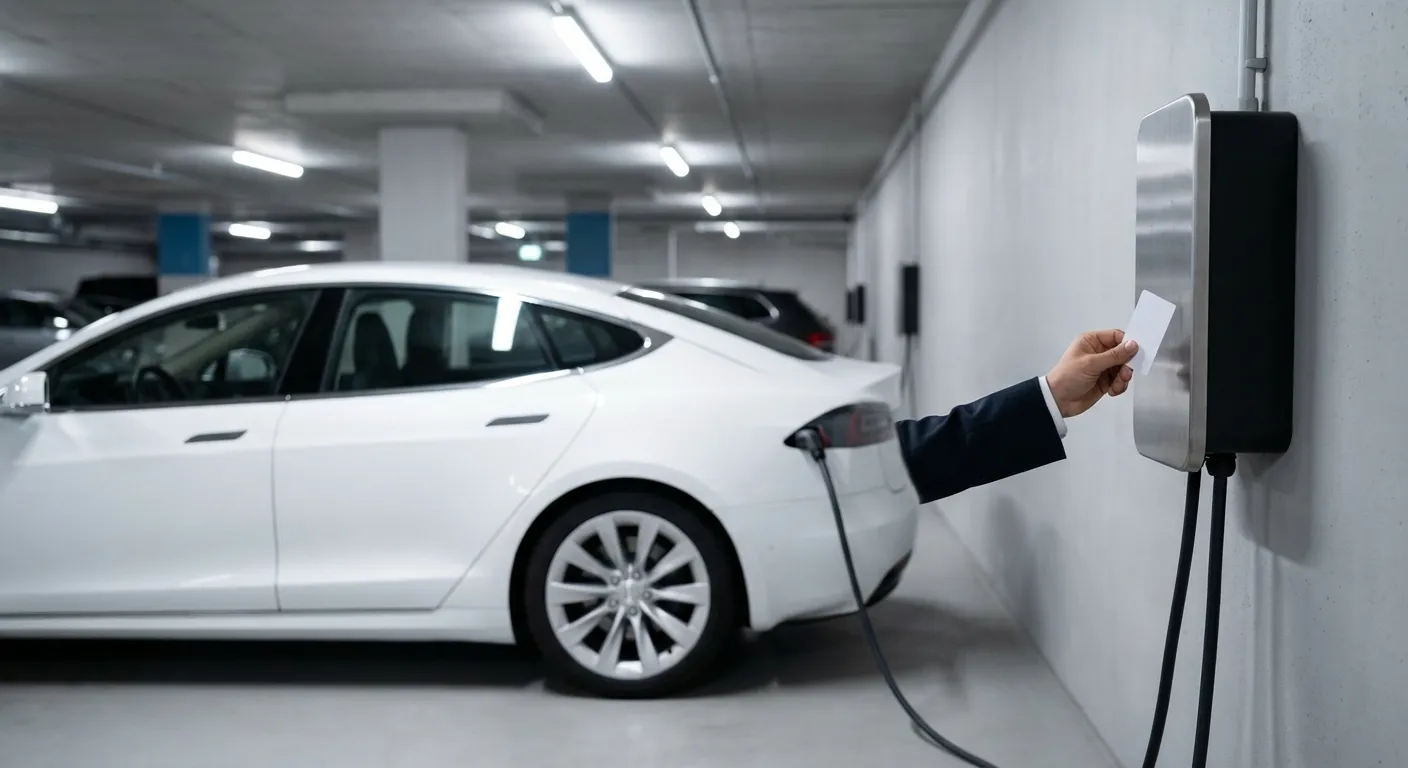
Europe's Alternative Fuels Infrastructure Regulation (AFIR) is reshaping public EV charging. Its payment rules, the 1 January 2027 retrofit deadline for a defined group of older high-power sites, and the technical standards referenced in the amended annex all affect charging operators. They do not, however, create a blanket requirement for every charger to offer Plug and Charge or make an RFID card itself "AFIR compliant." Operators need to assess each point by accessibility, power, location, and deployment or renovation date.
What AFIR Demands From Public Charging Stations
AFIR, which took effect in April 2024, establishes binding requirements for publicly accessible charging infrastructure across all 27 EU member states. The regulation's core principle is simple: any EV driver must be able to charge without prior registration or a subscription to a specific provider. Ad-hoc payment is now non-negotiable.
The payment requirements are tiered by power. Publicly accessible points deployed from 13 April 2024 must support ad-hoc payment. At 50 kW or above, operators must provide a payment-card reader or a contactless device that can read payment cards. Below 50 kW, a secure internet payment flow such as a session-specific QR code can qualify. One compliant terminal may serve several recharging points within the same recharging pool.
There is also a retrofit deadline. From 1 January 2027, publicly accessible points of 50 kW or more deployed before 13 April 2024 along TEN-T roads or at safe and secure parking areas must offer a payment-card reader or a contactless device that can read payment cards. The obligation is narrower than a retrofit of every older fast charger in Europe.
ISO 15118 and the Rise of Plug and Charge
From 8 January 2026, AFIR's amended technical annex references EN ISO 15118-2:2016 and EN ISO 15118-20:2022 for specified publicly accessible AC and DC points installed or renovated from that date. Those standards include optional functions. The regulation does not require every charger to activate a commercial Plug and Charge service; operators can decide whether to offer it and must implement it interoperably if they do.
There is no blanket January 2027 rule making ISO 15118-20 compulsory for every new or refurbished public or private charger. ISO 15118-20 supports functions including bidirectional power transfer, but the applicable AFIR technical requirement and the optional service functions must be read separately.
Where a compatible vehicle, charger, backend, certificate ecosystem, and commercial contract all support it, Plug and Charge can automate authentication. It remains one option alongside ad-hoc payment and contract RFID rather than a universal replacement.
Why RFID Still Matters for Fleet and Workplace Charging
AFIR's requirements primarily target publicly accessible charging infrastructure. Private and semi-private charging environments, including corporate workplaces, logistics depots, multi-tenant residential buildings, and fleet operations, operate under different dynamics where RFID-based authentication remains highly relevant.
Fleet operators managing dozens or hundreds of electric vehicles need centralized access control and precise per-vehicle or per-driver billing. RFID cards provide exactly this: each card links to a specific driver or vehicle in the backend management system, creating clean audit trails for energy costs, tax reporting, and operational analytics. A fleet manager can issue, reassign, or deactivate cards instantly without touching the physical charger.
Workplace charging presents similar requirements. Companies deploying chargers in employee parking areas need to restrict access to authorized personnel, track usage for benefit-in-kind calculations, and manage load across limited electrical capacity. Integrating RFID cards with existing employee ID badges creates a seamless system: the same card that opens the office door also activates the EV charger.
Multi-tenant buildings face perhaps the most complex access control challenge. Different residents, commercial tenants, and visitor parking all require distinct authorization levels. RFID-based systems handle this layered access elegantly, assigning different permission profiles to different card groups while routing billing to the correct tenant account.
Planning Against the Actual Scope
AFIR sets deployment targets and common requirements across the EU, but compliance is evaluated against the legal definitions and the characteristics of each installation. An operator's inventory should record whether a point is publicly accessible, its power output, whether it sits along TEN-T or at a safe and secure parking area, and when it was deployed or renovated. That inventory determines the applicable ad-hoc payment and technical requirements more reliably than continent-wide charger counts.
How RFID Adapts to the New Regulatory Landscape
An existing RFID reader should not be assumed to satisfy AFIR's payment requirements. Reading a charging credential and accepting a payment card are different functions, and a QR payment flow is allowed only for points below 50 kW. Operators should audit the installed payment hardware, power rating, location, and deployment date against Article 5 instead of treating a firmware update as universal compliance.
The Open Charge Point Protocol (OCPP) provides a standardized communication layer between charging stations and management platforms. A capable station and backend can support contract RFID alongside an ad-hoc payment integration, but OCPP support alone does not prove that the payment terminal, user flow, or installation meets AFIR. Roaming platforms and bilateral agreements can extend contract-token acceptance across networks.
For operators building new charging infrastructure in 2026, the practical approach is a layered authentication strategy: ISO 15118 Plug and Charge for compatible vehicles, contactless card payment for ad-hoc public access, and RFID cards for fleet management, workplace access control, and contracted user programs. This multi-method approach future-proofs the investment while maximizing accessibility for every type of EV driver.
The regulatory landscape is clear: Europe is moving toward frictionless, interoperable EV charging at unprecedented speed. RFID technology remains a critical piece of the puzzle, especially for private networks and fleet operations where centralized control and detailed usage tracking are business necessities.
Need RFID cards for EV charging within a layered authentication program? Browse our sustainable EV charging cards or explore fleet authentication and network roaming solutions built for OCPP and OCPI. The operator remains responsible for the payment, data, and infrastructure obligations that apply to each public charging point.
Company, network and product names referenced in this article are the trademarks of their respective owners. They are used descriptively to identify systems our cards interoperate with. ChargeRFID is an independent manufacturer and this article does not assert any affiliation, partnership or endorsement.
Primary sources
Official references used to review the regulatory, protocol, and chip-level claims in this guide.
Next step
Turn the research into a card specification.
Share the reader, chip, data or rollout context and we will identify the decisions required for samples and production.
Continue reading
Related Articles
ISO 15118 Plug and Charge vs RFID Cards: Which Authentication Will Win in 2026?
January 8, 2026 marked a pivotal moment for electric vehicle charging infrastructure. New regulations now require all public charging stations to support ISO 15118-2:2016, the standard enabling Plug & Charge technology. Does this spell the end for RF
RFID Authentication Goes Embedded: How Secure, Offline-Capable Charging Stations Are Reshaping EV Infrastructure
RFID Authentication Goes Embedded: Offline-Capable Charging Stations Reshape EV Infrastructure