By ChargeRFID
Review method: This organization-authored article reflects ChargeRFID's manufacturing perspective. Confirm chip, reader, charger, and backend compatibility in your own environment before ordering.
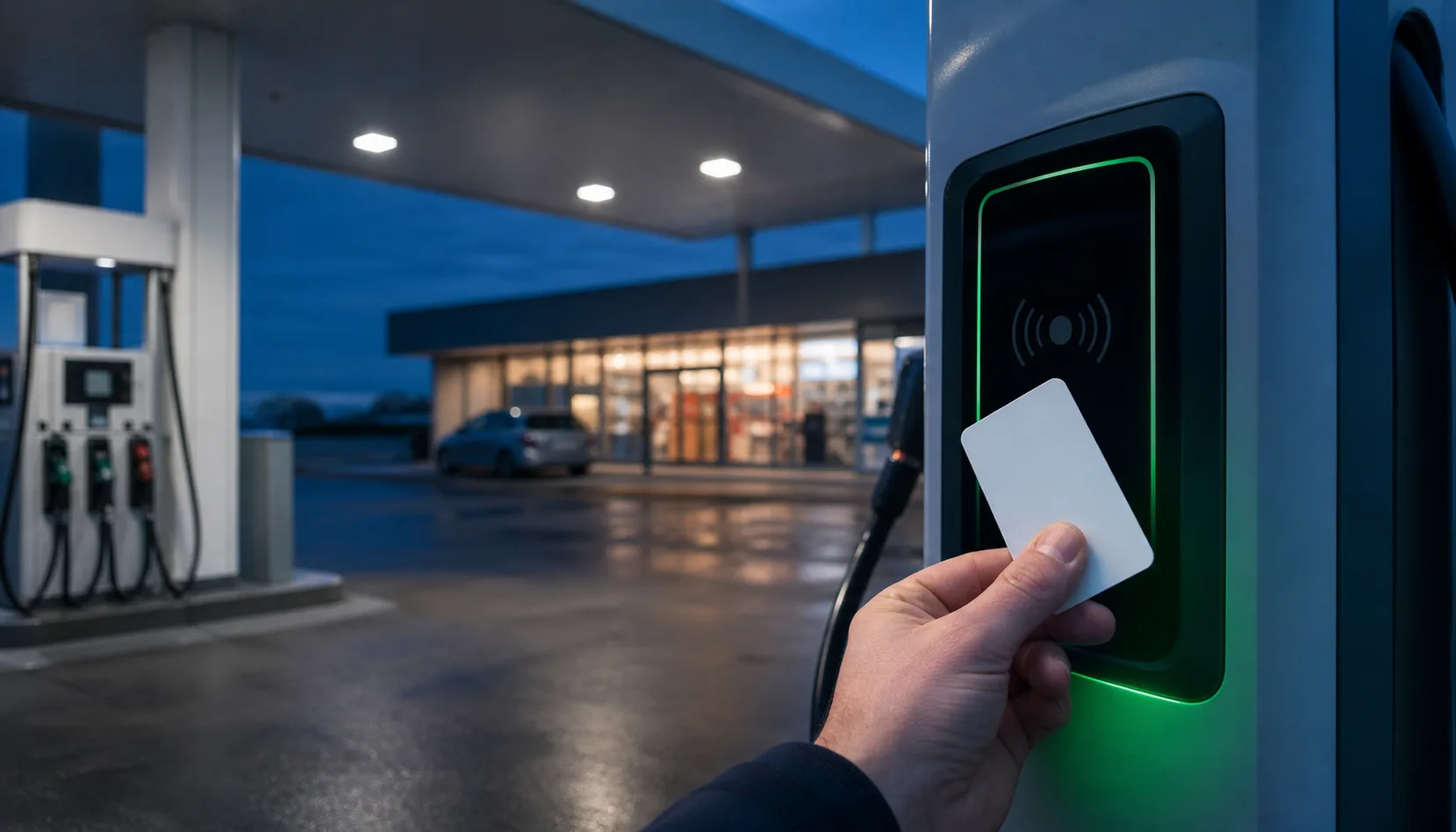
Across Germany, Austria, Switzerland, the Benelux, France, and the UK, the forecourt is quietly being rebuilt. Aral has rolled Aral pulse stalls onto thousands of legacy BP-branded sites. Shell Recharge is now in over 1,800 European stations. Q8, OMV, TotalEnergies, Circle K, and a long tail of independent Tankstellenbetreiber have all started the same conversion: yank an island of pumps, drop in 150–350 kW DC chargers, repaint the canopy, and keep the shop. The "petrol station" is becoming an "energy station." And the operators who are winning that transition are the ones rethinking the one piece of plastic every driver still pulls out of their wallet: the card.
This is a piece about what that card should actually do — and why a station operator who reaches out to us asking about "loyalty cards" usually walks away ordering something quite a bit more ambitious.
The Driver's Wallet Is a Mess
A typical European driver in 2026 is carrying, at minimum:
For private drivers this is annoying. For fleet drivers it is operationally expensive: every extra credential is a separate invoice, a separate VAT trail, a separate dispute case when a charger rejects a tap. Fleet managers we talk to consistently rank "too many cards per driver" in their top three pain points — above public charger reliability, behind only billing reconciliation (which is, fundamentally, the same problem).
The forecourt operator sits on the only piece of physical real estate where all of this collides. They have the pump. They have the charger. They have the POS in the shop. They have the car wash. Whoever issues the card that authenticates against all four wins the customer for the next five years.
What the Dual-Energy Card Actually Does
A dual-energy forecourt card is one RFID credential, issued by the station operator, that authenticates the driver at:
Behind the scenes there is exactly one card, one driver record, one invoice, one set of analytics. From the driver's pocket, there is one tap.
Why This Is Suddenly Buildable
Three things have lined up that make the dual-energy card a real product in 2026 rather than a deck-slide it was in 2021.
First, the chip families converged. The same AES-authenticated 13.56 MHz credential silicon that the EV-charging world standardised on (because it does mutual authentication with AES-128 and survives the rough OCPP idTag matching that every CPO does slightly differently) is also fully supported by the forecourt POS terminals from Ingenico, Verifone, and the German payment-terminal duopoly of Hypercom and CCV. The card you would already pick for an EV roaming programme is the card the petrol station's existing POS can already read.
Second, the roaming infrastructure exists. a roaming provider's intercharge network and a roaming provider in France give a station operator a single integration point to register card UIDs and have them recognised at hundreds of thousands of chargers across Europe. The hard part of "make my card work at someone else's stall" is solved; what's left is a business-process question (do you want it to, and how do you split the revenue).
Third, fleet demand is real and loud. The mixed ICE-and-EV fleet is now the norm, not the future — most logistics, taxi, last-mile, and corporate fleets in the DACH region are running 20–60% EV mix and rising 5–10 points per year. Fleet managers will pay a premium for a card that closes their reconciliation problem. A petrol station that issues a dual-energy fleet card has a defensible B2B product, not just a loyalty programme.
What the Card Actually Looks Like (Spec)
A workable dual-energy forecourt card, for a station chain rolling out 50,000–500,000 cards across a country, looks like this:
Where Operators Get This Wrong
The pattern of failure is consistent across the projects we've seen launched (and a few we've been asked to rescue):
The Pitch If You're a Station Operator Reading This
If you operate a petrol-station network — a chain of ten sites, a Tankstellenbetreiber group in DACH, an independent in Eastern Europe pivoting to EV — and you were about to brief a vendor for "loyalty cards," consider briefing them for a dual-energy programme instead. The incremental cost over a plain loyalty card is meaningful but small. The incremental defensibility against the day a Shell Recharge or Aral pulse card walks into your forecourt and steals your customer is enormous.
We've built EV charging card programmes at every scale from regional CPO pilots to the 1.3-million-charger a selected roaming programme network. We've shipped FSC wooden cards for the the automaker its European EV campaign launch and recycled-PVC fleet cards for a selected EV charging programme in Luxembourg. We have not yet shipped a card that does *all four* things — fuel, charge, shop, wash — at scale, because the operator side of that conversation has only just become serious in the last twelve months. We'd like to.
Where to Start
If you're at the "interesting, but what's the actual ask" stage:
Browse our recycled PVC and FSC wooden RFID cards for the form factors and chip families. Read how we built the a selected roaming programme roaming credential and the a selected EV charging programme fleet card for two ends of the deployment spectrum. Or talk to us directly — tell us how many sites and how many cards, and we'll come back with a buildable spec and a price.
Company, network and product names referenced in this article are the trademarks of their respective owners. They are used descriptively to identify systems our cards interoperate with. ChargeRFID is an independent manufacturer and this article does not assert any affiliation, partnership or endorsement.
Next step
Turn the research into a card specification.
Share the reader, chip, data or rollout context and we will identify the decisions required for samples and production.
Continue reading
Related Articles
Fleet RFID Charging Cards: A Guide for Commercial EV Operations
How fleet RFID charging cards work for commercial EV operations: per-vehicle kWh tracking, OCPP integration, programme-specific reporting, multi-depot key management, and what to spec when issuing cards to drivers.
Choosing an RFID Credential for EV Charging
A vendor-neutral method for choosing a 13.56 MHz EV charging credential by reader behavior, identifier format, authentication, backend controls and roaming requirements