By ChargeRFID
Review method: We checked this guide against the primary regulatory, protocol, and manufacturer references listed below. Product recommendations reflect ChargeRFID's manufacturing perspective and should be validated with your reader, charger, and backend.

Running a commercial fleet on electric vehicles changes the economics of charging. Instead of one driver swiping a personal credit card at a forecourt, you have 50, 500, or 5,000 drivers charging across depots, public stations, and home chargers — each session generating cost, kWh, and tax-relevant data that has to land cleanly in fleet management software. Fleet RFID charging cards are how that data gets captured at the source.
This guide covers what makes a fleet RFID charging card different from a consumer card, how the authentication and reporting chain works, and what to specify when issuing cards across a commercial EV program.
What Makes a Fleet RFID Charging Card Different
A charging card presents a token. Whether that token represents a driver, vehicle, depot, cost centre, or contract is determined by the fleet and charging backends. One card does not inherently identify all of those entities at once.
The card may use AES-authenticated 13.56 MHz credential or another reader-compatible technology. The important distinction is how its identifier or protected application is provisioned and mapped in the backends:
How Fleet RFID Authentication Works on OCPP Stations
The authorization and transaction flow depends on the OCPP version. A typical OCPP 1.6 path looks like this:
When a driver taps a fleet card at a depot or public station:
For fleets running mixed depot + public charging, OCPI roaming feeds CDRs from external CPOs back through the fleet's MSP into the same reporting pipeline.
Per-Vehicle vs Per-Driver Card Models
Most fleets choose between two architectures:
Per-vehicle cards sit with the vehicle (in the glovebox or attached to a key fob). Pros: simple driver experience, easy reassignment when drivers swap. Cons: stolen with the vehicle, can't isolate driver behavior.
Per-driver cards travel with the driver across vehicles. Pros: direct driver-level attribution. Cons: accurate vehicle and mileage allocation still requires assignment or telematics data, and tax treatment must follow the applicable HMRC rules rather than the card model alone.
Many large fleets issue both — a per-driver card for cost allocation, a per-vehicle key fob for redundancy and ease of access.
Multi-Depot Key Management
For fleets running multiple depots, authorization can be enforced in the backend by token group, vehicle, driver, or site. AES-authenticated 13.56 MHz credential also supports diversified application keys when the deployed readers authenticate a protected application rather than reading only the public UID.
With a correctly designed protected application, separate key domains can limit the scope of a key compromise. Rotating those keys still requires a documented reader, card, secure-module, and backend process; a public-UID authorization scheme instead revokes individual or grouped tokens in the backend.
Avoid one shared application key across an entire fleet, but do not add card keys that the charging readers and backend never authenticate. Match the control to the actual authorization architecture.
Reporting: From OCPP CDR to HMRC-Ready Output
The card is just the entry point. The reporting chain is what makes a fleet program work financially.
A typical UK fleet workflow:
The card-to-report chain should be auditable end to end. That audit trail normally comes from station meter values, OCPP events, CPO/eMSP session and CDR records, tariff data, token mappings, and fleet metadata. AES-authenticated 13.56 MHz credential transaction-MAC features do not automatically create or validate the backend charging CDR, especially when a charger reads only the card UID.
Roaming for Mixed Depot + Public Charging
Most commercial fleets can't operate on depot-only charging. Long-haul drivers, last-mile operators with route variance, and any fleet with home-charging policies all need public network access via the same card.
This is where token publication and active roaming agreements matter. A fleet card issued by an eMSP can work at contracted CPOs reached through a hub or direct OCPI/OICP connection. Coverage should be taken from the eMSP's current contractual network list; a platform's total connected-point count is not a guarantee that a particular card is accepted everywhere.
The CDRs come back to the fleet's MSP, get re-priced if the contract uses a markup model, and flow into the same reporting pipeline as depot sessions.
What to Specify When Issuing Fleet RFID Charging Cards
An example procurement checklist is:
Common Mistakes in Fleet Card Programs
Where to Go From Here
A fleet RFID charging card program is a four-axis spec: chip security, encoding format, roaming reach, and reporting integration. Get those right and the cards become invisible infrastructure — drivers tap, energy flows, data lands cleanly in the fleet's books.
Browse our recycled PVC and FSC wooden EV charging cards or read how we built fleet card programs with a selected EV charging programme and a selected fleet charging programme. Talk to us about your fleet's charging program — we'll help you spec the right card and align it with your MSP.
Company, network and product names referenced in this article are the trademarks of their respective owners. They are used descriptively to identify systems our cards interoperate with. ChargeRFID is an independent manufacturer and this article does not assert any affiliation, partnership or endorsement.
Primary sources
Official references used to review the regulatory, protocol, and chip-level claims in this guide.
- Open Charge Point Protocol (OCPP)Open Charge Alliance
- Open Charge Point Interface (OCPI) specificationEV Roaming Foundation
- Electric company-car tax treatmentHM Revenue & Customs
- Advisory electric rates for company carsHM Revenue & Customs
Next step
Turn the research into a card specification.
Share the reader, chip, data or rollout context and we will identify the decisions required for samples and production.
Continue reading
Related Articles
RFID Roaming: How One Card Works Across Participating EV Charging Networks (2026 Guide)
One RFID card, every charging network. How EV roaming works through OCPI and OICP, why drivers stop juggling an app per network, and how fleets get one card and one invoice across 1M+ chargers in 2026.
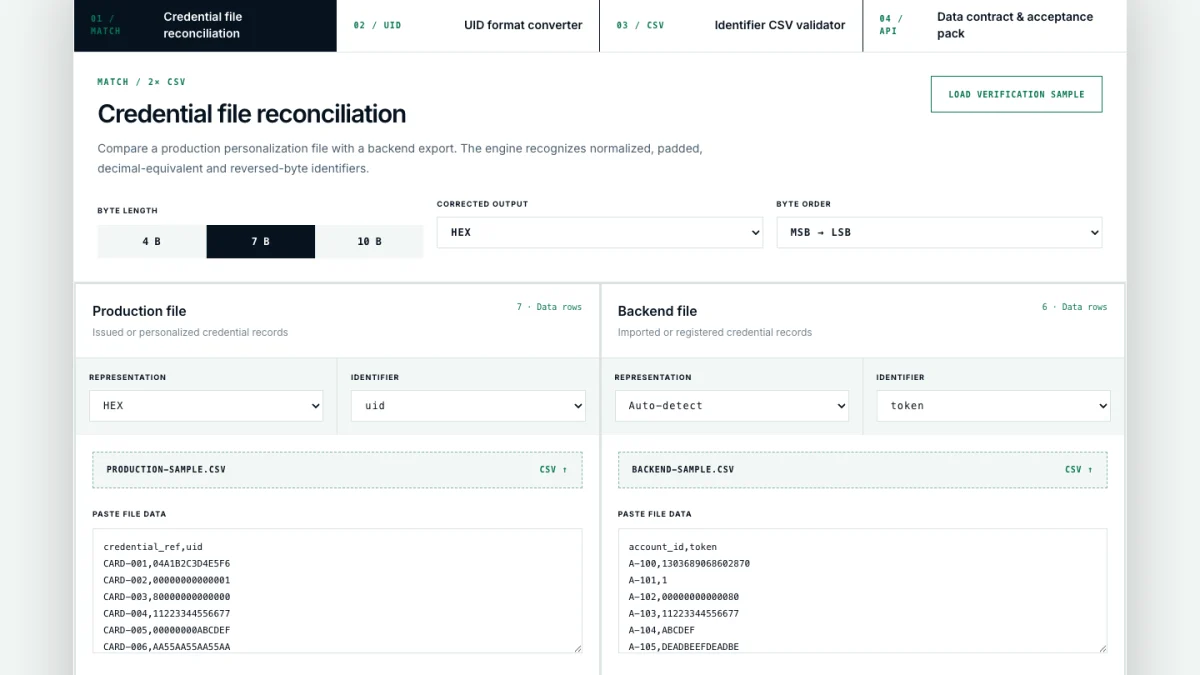
A Free RFID Credential Reconciliation Tool for EV Charging Teams
Compare production and backend credential files, expose UID formatting mismatches, and export the evidence needed to correct an RFID rollout before launch.